
Why the list matters
A ship trades on its certificates. Charterers and terminals ask for them, insurers rely on them, and a Port State Control inspection usually starts with them. An expired certificate, or a survey done outside its window, can keep the ship in port until it is put right.
Most certificates are valid for five years, but almost all of them need surveys in between. That is why a list of expiry dates alone is not enough: the survey windows inside those five years matter just as much.
Who issues them
- The flag state issues the statutory certificates, or authorises a recognised organization, usually a classification society, to survey the ship and issue them on its behalf.
- The classification society issues the class certificates and keeps the ship in class through its own surveys.
- The flag state, on evidence of insurance, issues the liability certificates required by the Bunkers and Wreck Removal conventions. The P&I club provides the insurance behind them.
- The company holds the Document of Compliance under the ISM Code. The ship carries a copy.
The core list for a cargo ship
This is the usual set for a cargo ship of 500 GT and above on international voyages. Smaller ships, tankers, chemical and gas carriers and passenger ships carry other or additional certificates, listed further down.
| Certificate | Convention | Validity | Surveys |
|---|---|---|---|
| International Tonnage Certificate | Tonnage 1969 | No expiry. Reissued after changes to the ship | None |
| Certificate of Registry | Flag law | Set by the flag | Set by the flag |
| Continuous Synopsis Record | SOLAS XI-1 | No expiry. Updated on every change | None |
| Minimum Safe Manning Document | SOLAS V | Set by the flag | Set by the flag |
| International Load Line Certificate | Load Lines 1966 | 5 years | Annual |
| Cargo Ship Safety Construction Certificate | SOLAS | 5 years | Annual, intermediate, two bottom inspections in 5 years |
| Cargo Ship Safety Equipment Certificate (Form E) | SOLAS | 5 years | Annual, periodical |
| Cargo Ship Safety Radio Certificate (Form R) | SOLAS | 5 years | Periodical |
| International Oil Pollution Prevention Certificate (IOPP) | MARPOL Annex I | 5 years | Annual, intermediate |
| International Sewage Pollution Prevention Certificate (ISPP) | MARPOL Annex IV | 5 years | Renewal |
| International Air Pollution Prevention Certificate (IAPP) | MARPOL Annex VI | 5 years | Annual, intermediate |
| International Energy Efficiency Certificate (IEE) | MARPOL Annex VI | Life of the ship | New certificate after a major conversion |
| International Anti-fouling System Certificate (IAFS) | AFS 2001 | No expiry | Endorsed when the coating system changes |
| International Ballast Water Management Certificate | BWM 2004 | 5 years | Annual, intermediate |
| Document of Compliance (copy on board) | ISM Code | 5 years | Annual verification of the company |
| Safety Management Certificate (SMC) | ISM Code | 5 years | Intermediate verification |
| International Ship Security Certificate (ISSC) | ISPS Code | 5 years | Intermediate verification |
| Maritime Labour Certificate and DMLC | MLC 2006 | 5 years | Intermediate inspection |
| Bunker pollution liability certificate | Bunkers 2001 | To the end of the insurance, usually one year | Renewed with the insurance |
| Wreck removal liability certificate | Nairobi 2007 | To the end of the insurance, usually one year | Renewed with the insurance |
| Certificate of Class | Class rules | 5 years | Annual, intermediate, special survey |
A summary for planning. Size limits and details differ between conventions; the flag state, class and the conventions as amended are the reference for each vessel.
Some ships carry the three SOLAS certificates for construction, equipment and radio as one Cargo Ship Safety Certificate. Insurance documents for crew repatriation and contractual claims under MLC 2006 are issued by the insurer and are usually kept with the liability certificates.
How the survey windows work
Most statutory certificates follow the harmonized system of survey and certification, so their dates line up. The anniversary date is the day and month of the certificate's expiry, in every year of its validity.
- Annual survey: within 3 months before or after each anniversary date.
- Intermediate survey: within 3 months before or after the second or third anniversary date. It takes the place of one annual survey.
- Renewal survey: when it is completed within 3 months before expiry, the new certificate runs 5 years from the old expiry date. When it is completed earlier, the 5 years count from the date the survey is completed.
- Bottom inspections: two inspections of the outside of the bottom in each 5-year period, one of them at the renewal, with no more than 36 months between them.
- ISM, ISPS and MLC: the ship certificates have an intermediate verification or inspection between the second and the third anniversary date. The company's Document of Compliance is verified every year.
Every survey is endorsed on the certificate. If an annual or intermediate survey is missed, the certificate can lose its validity long before the expiry date printed on it. In limited cases the flag can extend a certificate to let the ship reach the port of survey, but this is an exception to ask for, not a plan.
Other ship types
- Oil tankers: IOPP with its Form B, and a civil liability certificate when the ship carries more than 2,000 tonnes of oil in bulk.
- Chemical tankers: a Certificate of Fitness for the carriage of dangerous chemicals in bulk, or an NLS certificate.
- Gas carriers: a Certificate of Fitness for the carriage of liquefied gases in bulk.
- Ships carrying dangerous goods: a Document of Compliance for the carriage of dangerous goods.
- Bulk carriers loading grain: a document of authorization for the carriage of grain.
- Passenger ships: a Passenger Ship Safety Certificate, valid for no more than 12 months.
- Ships in polar waters: a Polar Ship Certificate.
Keeping the list under control across a fleet
With ten ships and twenty certificates each, there are two hundred expiry dates and several hundred survey windows to follow. What works in practice:
- One register, the same names on every ship. When each vessel uses its own spelling, a fleet view is impossible.
- Record the windows, not only the expiry. For each certificate keep the anniversary date and the next survey window.
- Keep the scan next to the record. After every survey, file the endorsed certificate, so the copy on file is the current one.
- Warn early. Three to six months ahead is usually enough to book the surveyor and fit the survey into the ship's schedule.
- Plan surveys together. Put annual surveys, the intermediate survey and the bottom inspection on the same calendar as dry docks and port calls.
- Let the ship see the list. The master should see the same dates as the office, also without a connection.
Before the next Port State Control inspection
- All certificates on board are originals and valid.
- Every annual and intermediate survey is endorsed within its window.
- Expired or replaced certificates are removed from the certificate file.
- Names, IMO number and flag match on all certificates.
- Conditions of class and recommendations are known and within their dates.
- Insurance certificates are valid for the new policy year.
- The Minimum Safe Manning Document matches the crew on board.
- The office and the ship hold the same list.
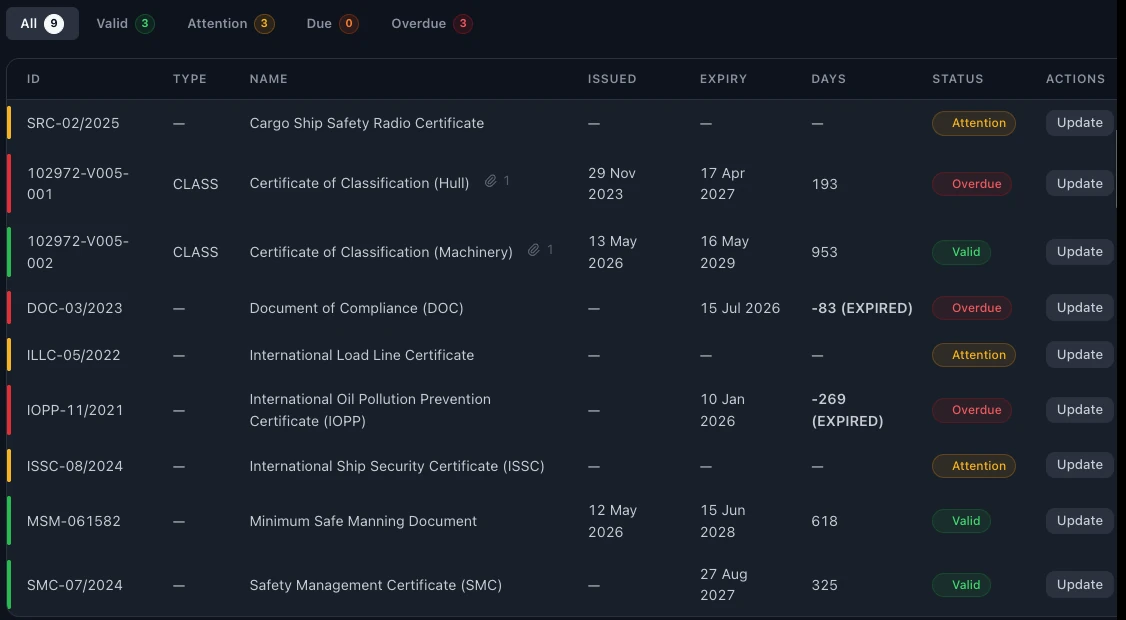
Tracking certificates in SEA360
SEA360 keeps statutory, class and insurance certificates for every vessel in one register, with expiry dates, survey windows and the scanned copy attached. Each certificate is marked valid, attention, due or overdue, the office gets an email before a certificate or a survey window comes due, and the fleet dashboard shows the certificates due next to each vessel. The crew see the list and the scans on board, also without a connection, and the register can be exported to Excel or PDF at any time.