
What section 10.3 asks
Section 10 of the ISM Code is about maintaining the ship and its equipment. Section 10.3 adds three things for a special group of equipment:
- Identify it. The company decides which equipment and technical systems could create a hazardous situation if they failed suddenly.
- Make it more reliable. The safety management system includes specific measures for that equipment, beyond the normal maintenance.
- Test what stands by. Stand-by arrangements, and equipment that is not in continuous use, are tested regularly.
The Code does not give a list. Each company makes its own, for its own ships, and must be able to explain why each item is on it.
What "critical" means
Critical does not mean expensive, or important to the owner. It means that a sudden failure could lead to a hazardous situation for the people on board, the ship or the environment.
It helps to think of two groups:
- Equipment in use, where a sudden stop is the danger: propulsion, steering, power generation, navigation.
- Equipment on stand-by, which is only needed in an emergency and may not be noticed as broken until then: the emergency generator, the emergency fire pump, lifeboat engines, emergency steering.
The second group is where most surprises are. A stand-by machine that has not run for months can look perfect and still fail to start.
How to build the list
- Start from the systems, not from the equipment list: propulsion, steering, power, fire fighting, life-saving, navigation, closing devices, pollution prevention.
- Ask one question for each item: if this fails suddenly, what happens? Think of the worst moment, such as manoeuvring in port, heavy weather or a narrow channel.
- Look at redundancy. A second pump that takes over automatically changes the answer. A second pump that has to be started by hand in the engine room may not.
- Ask the people on board. The master and the chief engineer know which failures they fear on that ship.
- Write down the reason for each item, so an auditor can see how the list was made.
- Keep it the same on sister ships, and mark the items in the maintenance plan, not only in the safety management manual.
- Review it after incidents, near misses, modifications and changes of trade.
Typical critical systems
| System | Example equipment | If it fails suddenly | Typical measures |
|---|---|---|---|
| Propulsion | Main engine, reduction gear, controllable pitch propeller | Loss of propulsion near the coast or in traffic | Condition monitoring, planned overhauls, spares on board |
| Steering | Steering gear, emergency steering | Loss of steering | Tests before departure, emergency steering drills |
| Electrical power | Main generators, emergency generator, emergency switchboard, batteries | Blackout | Regular start and load tests, battery checks |
| Fire fighting | Emergency fire pump, fixed fire-extinguishing system, fire detection | A fire that cannot be controlled | Test runs, servicing by approved companies |
| Life-saving | Lifeboat engines, release gear, davits and winches | The crew cannot abandon ship | Weekly and monthly checks, annual and five-yearly servicing |
| Navigation and communication | Radar, gyro compass, ECDIS, GMDSS equipment | Collision or grounding, no distress alert | Daily checks, annual radio survey |
| Closing devices | Watertight doors, quick-closing valves, fire dampers | Flooding or the spread of fire | Regular operation tests |
| Pollution prevention | Oily water separator and 15 ppm alarm | Illegal discharge | Tests and calibration |
Examples only. Each company decides its own list from its own assessment of its ships and trade.
Measures that make it reliable
The specific measures are what turns a list into something useful. The usual ones:
- Tighter maintenance: shorter intervals, or condition monitoring such as vibration and oil analysis.
- Critical spare parts on board, with a minimum stock that is checked.
- No postponement without the office: a job on critical equipment is only postponed with a reason, an approval and a new date.
- Defects reported at once, and followed up until closed.
- Clear changeover and emergency procedures, and crew who have practised them.
- Records of every job and every test.
Testing stand-by equipment
For each item on stand-by, the test routine should answer five questions: what is tested, how often, what result counts as a pass, who does it and where it is recorded. For example:
- Emergency generator: start on automatic, take the load, run for a set time.
- Emergency fire pump: start, deliver pressure at the highest hydrant.
- Lifeboat engines: run ahead and astern during the weekly inspection.
- Steering gear: test before departure, and practise emergency steering at regular drills.
- Quick-closing valves and remote stops: operate them and check that they close fully.
A test that is done and not recorded is, for an auditor, a test that was not done.
Common mistakes
- Everything is critical. A list of three hundred items gets no special attention at all.
- The list lives only in the manual. If the maintenance plan does not show which jobs are critical, nobody treats them differently.
- Tests without records, or records without the result.
- Quiet postponements of jobs on critical equipment.
- The list is never reviewed, even after a failure that should have changed it.
What auditors and inspectors ask
- Which equipment is critical on this ship, and how did you decide?
- What specific measures do you apply to it?
- When was the emergency generator last tested, and where is the record?
- Are there overdue or postponed jobs on critical equipment, and who approved them?
- Which critical spare parts are on board?
Checklist
- A list of critical equipment and systems for each ship, with the reason for each item.
- The same list on sister ships.
- Critical equipment marked in the maintenance plan.
- Specific measures written for each item.
- A test routine for every stand-by item: what, how often, pass result, who, record.
- Test records on board and up to date.
- No overdue jobs on critical equipment, or an approved postponement.
- Critical spare parts identified and in stock.
- The list reviewed after incidents and modifications.
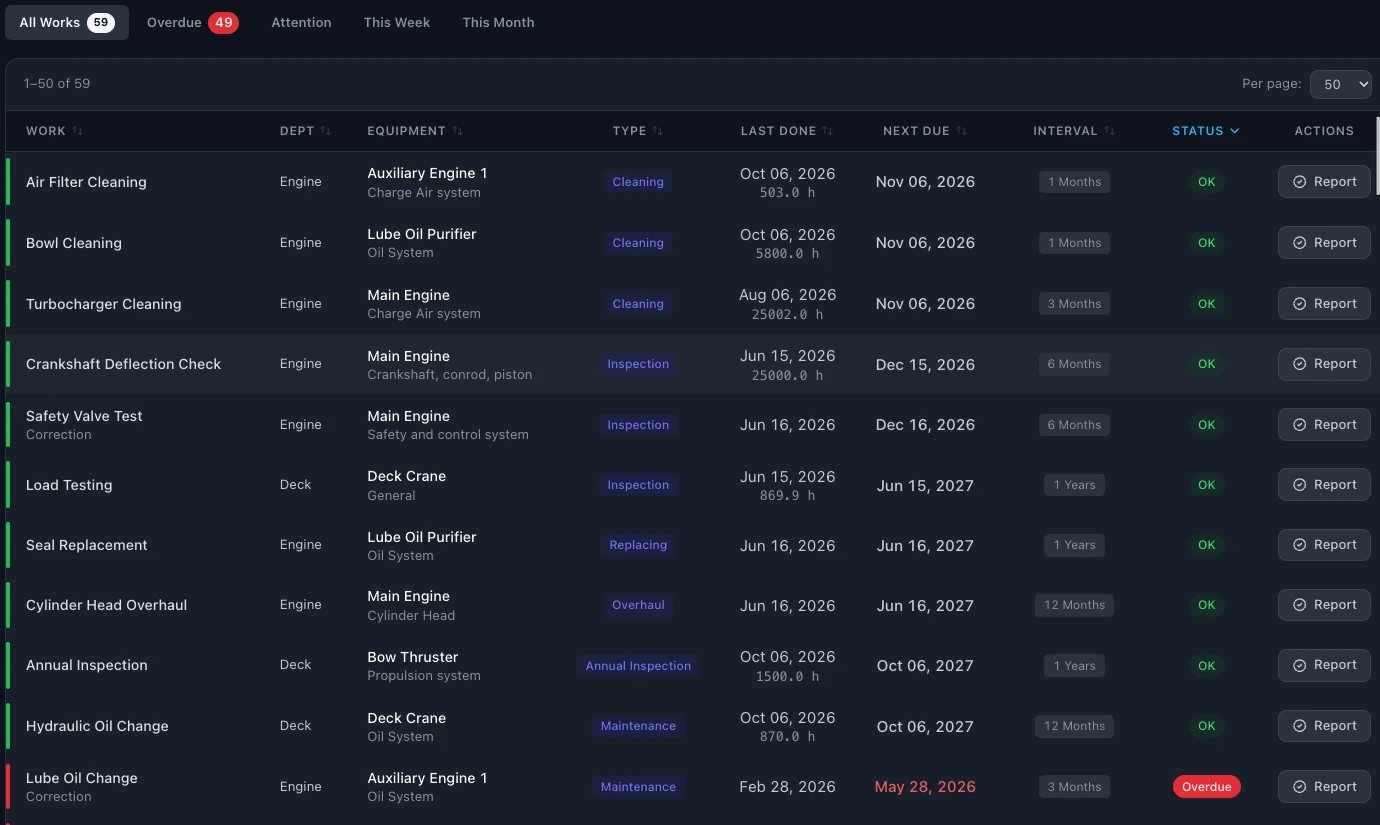
Critical equipment in SEA360
In SEA360 critical equipment is flagged in the maintenance plan, with its test history. Jobs are planned by date, by running hours or both, the plan can be filtered by what is overdue, due this week or due this month, and every completed job keeps its date, running hours and remarks. When an auditor asks, the job history for each piece of equipment can be exported to PDF, and every change is recorded in the system log. When you move to SEA360, we help you set up running hours and critical equipment.