
Why the spare matters as much as the job
A ship can have a perfect maintenance plan for its critical equipment and still be stuck in port for two weeks, because the one part that failed is in a warehouse on another continent. For equipment whose sudden failure is dangerous, the spare part on board is part of the reliability measures that section 10.3 of the ISM Code asks for.
The aim is not a full store of everything. It is the right parts, in the right number, in good condition, and a stock record you can trust.
What makes a spare part critical
A spare is critical when three things are true at the same time:
- The equipment is critical. It is on the company's list of equipment whose sudden failure could cause a hazardous situation.
- Without the part, the equipment stops or cannot be used safely, and there is no simple workaround.
- The part cannot be had in time where the ship trades: long lead times, few suppliers, remote ports.
A filter that every port can supply in a day may be important, but it is rarely critical. A seal kit for the steering gear pump that takes six weeks to arrive usually is.
How to build the list
- Start from the critical equipment list, not from the store. Every critical spare belongs to a piece of critical equipment.
- Take the makers' recommended spares for each item. In some cases class or flag rules add to them.
- Look at the history: what has failed on this ship and on the sister ships, and how often.
- Check the lead times for the ship's trading area with your usual suppliers.
- Decide the quantity on board for each part, and mark the part as critical in the stock list.
- Keep the same list on sister ships. Where it makes sense, keep one set ashore for the whole class of ships.
- Review it after failures, modifications and changes of trade.
Typical critical spares
| Equipment | Typical critical spares | Why they are on board |
|---|---|---|
| Main engine | Fuel injectors, exhaust valve, gaskets and seal kits for the cylinder unit | Long lead times; the engine cannot run safely without them |
| Auxiliary engines | Fuel injection pump, injectors, filter elements | A second failure while one engine is down means a blackout |
| Steering gear | Hydraulic pump, seal kits, solenoid valves | Loss of steering |
| Emergency generator | Starter motor, batteries, fuel filters | It has to start the first time it is needed |
| Emergency fire pump | Mechanical seal, impeller, coupling | No fire fighting if the main pumps are lost |
| Lifeboats | Engine starter and filters, parts for the release gear | The crew must be able to abandon ship |
| Oily water separator | 15 ppm alarm sensor, filter elements | No legal discharge of bilge water |
Examples only. The makers' recommendations and the company's own experience decide the list for each ship.
Setting the minimum stock
A simple way to set the minimum for each critical part:
- Enough for one complete repair, plus
- what the ship normally uses during the time it takes to get the part delivered.
When the stock falls below the minimum, the part is reordered at once, not with the next routine order. A part used in an emergency is replaced before the ship needs it again.
Condition matters as much as quantity. Rubber seals and O-rings age, batteries lose capacity, and parts stored in a damp locker corrode. Check them at set intervals, and follow the makers' storage advice.
Keeping the stock records true
- Record every use when the job is done, not at the end of the month.
- Receive every delivery into stock on board, with the right part number.
- Count the critical spares at set intervals, and correct the records.
- Record transfers between ships.
- Check the stock after a dry dock, when many parts are used and many arrive.
- Watch for superseded part numbers. A part that is no longer made may need a new source or a new solution.
Common mistakes
- The spares list is not linked to the critical equipment list, so nobody knows which parts really matter.
- The records show parts that are not on board, because uses were never recorded.
- A critical part is used and not reordered until it is needed again.
- Wrong or old part numbers, and the wrong part arrives.
- Parts kept in poor condition: corroded, expired, or with no one sure what they are.
- The minimum was set years ago and never changed after failures or a change of trade.
What auditors and inspectors ask
- Which spares do you keep for the critical equipment, and how did you decide?
- Can you show me this part on board, where the record says it is?
- What happens when stock falls below the minimum?
- This part was used last month. Has it been reordered?
Checklist
- Every critical spare belongs to an item on the critical equipment list.
- Quantities on board are set and recorded for each critical part.
- Critical parts are marked in the stock list.
- Stock below minimum triggers a requisition at once.
- Uses and deliveries are recorded when they happen.
- Critical spares are counted and their condition checked at set intervals.
- Part numbers are checked against the makers' latest lists.
- The list is the same on sister ships, and reviewed after failures.
Spare parts in SEA360
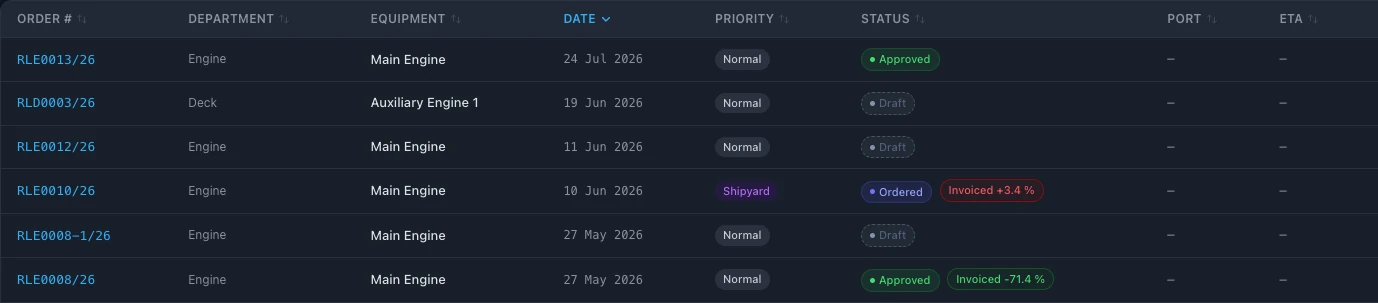
SEA360 shows what is on board for every spare part and store, with minimum levels and a warning when stock falls below them. The crew raise requisitions on board, the office approves them through the approvals you set, compares supplier quotes side by side and follows each order to its port of delivery. Delivered items are received into stock on board, the invoice is checked against the order line by line, and orders count against each vessel's budget.