
What the specification is for
The dry dock specification is the list of work the vessel needs in the yard. The yards price it, the superintendent follows it during the docking, and the final invoice is checked against it.
A good specification does three things:
- it tells every yard exactly the same thing, so their quotes can be compared;
- it gives each job a quantity and a unit, so the price of every item is clear;
- it leaves less room for extra work that nobody put in the budget.
When to start
Start from the survey dates. The class renewal or intermediate survey usually sets the docking window, and a good yard slot often has to be booked months ahead. A common order, to adjust to your fleet and trade:
- 9 to 12 months before: confirm the survey window and the docking period with class and with the commercial team.
- 6 to 9 months before: collect the scope and send the first specification to the yards.
- 3 to 6 months before: compare the quotes, clear the questions, choose the yard and fix the dates.
- The last month: issue the final specification, order the owner's supplies and spare parts, plan who attends.
Where the scope comes from
Most of the scope is already written somewhere. The work is to bring it together before the specification goes out:
- Class and statutory items due at this survey: bottom survey, tail shaft, rudder, anchors and chains, sea valves.
- Maintenance jobs in the maintenance plan that can only be done in dock, or that were postponed to the dock.
- Defects reported by the crew, and open findings from inspections, audits and Port State Control.
- Hull and coating condition from the last docking and from diver inspections since then.
- Modifications and retrofits planned for this docking.
- Makers' recommendations for the main engine, the propeller and the stern tube seals.
Go through the list with the chief engineer and the master before the specification is sent. A job found in the yard costs more than the same job in the quote.
How the specification is organised
Most specifications follow the same order. Yards are used to it, and keeping it from one docking to the next makes your own quotes comparable over the years.
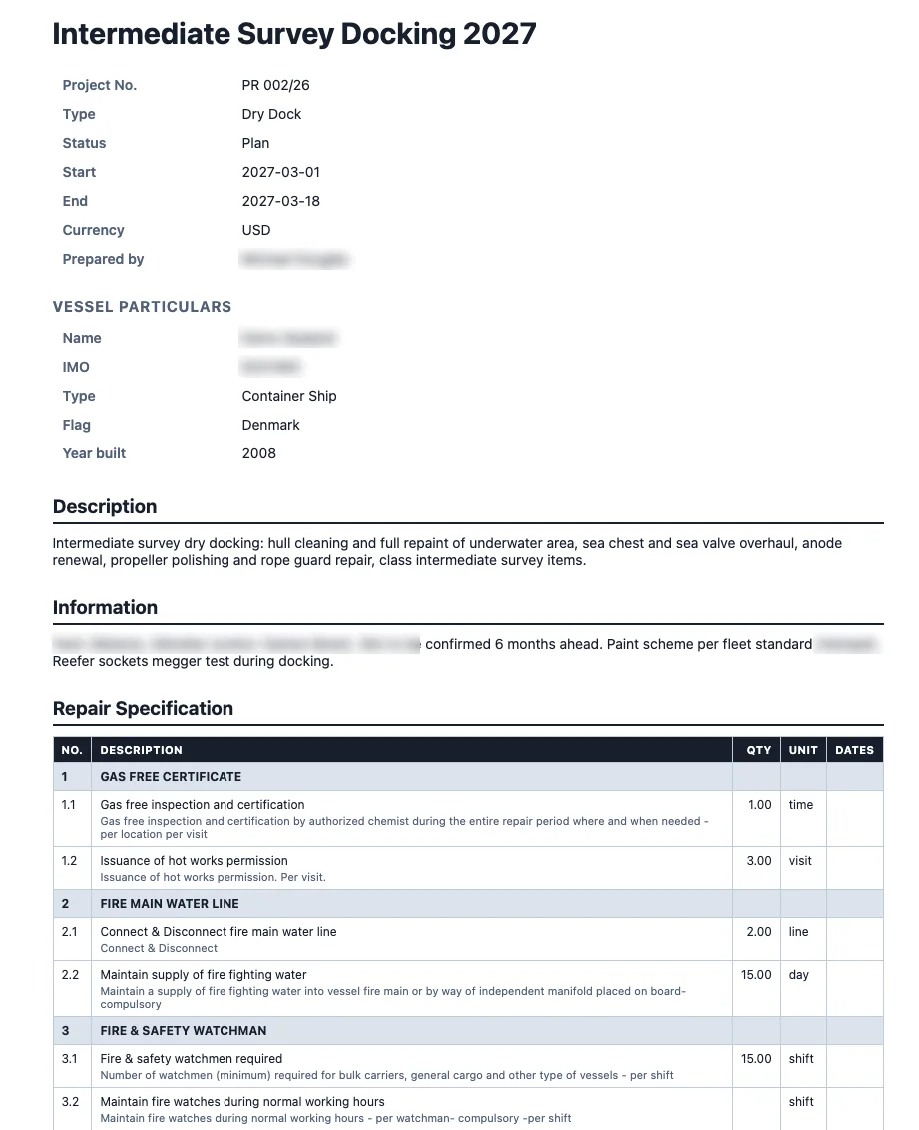
- General information: vessel particulars, type of survey, planned dates, currency, who prepared the specification.
- General services: docking and undocking, dock days and berth days, gas free certificate, fire main supply, fire and safety watchmen, shore power, cooling water, garbage removal, cranage and staging.
- Hull: washing, blasting and painting by area, hull markings, anodes.
- Sea chests and sea valves.
- Propeller, tail shaft and rudder: polishing, clearances, seals, rope guard.
- Anchors and chains: ranging, measuring, marking.
- Machinery: main and auxiliary engines, pumps, coolers and heat exchangers.
- Steel renewal: by weight, with a unit rate for extra steel.
- Electrical and automation.
- Deck and cargo equipment: hatch covers, cranes, mooring equipment.
- Owner's supply and owner's work: what the owner delivers and what the crew does.
How to write one item
Each item should answer the same questions, so a yard can price it without calling you:
- Number. 1, 1.1, 1.2. Keep the same numbers in every quote and in the final invoice.
- What and where. "Overhaul sea valve DN 200, port sea chest", not "valves as required".
- Quantity and unit. m² for blasting and painting, kg for steel, pcs for valves and anodes, day for services, shift for watchmen.
- Scope of the job. Open, clean, inspect, renew parts, close, test. Say who presents the job to class.
- Supply. Yard supply or owner's supply, with the material described by its specification.
- Access. Removal of insulation, staging, tank cleaning: anything the yard must do before the job itself.
- Extras. A unit rate for work that may grow, such as extra steel per kg or extra blasting per m².
| No. | Description | Qty | Unit |
|---|---|---|---|
| 3.4 | Grit blasting of vertical sides, boot top area, to Sa 2.5. Unit rate for extra area. | 650.00 | m² |
| 4.2 | Overhaul sea valve DN 200, port sea chest. Open, clean, inspect seat and disc, lap, renew gasket and packing, close, pressure test, present to class. Spares: owner's supply. | 2.00 | pcs |
| 8.1 | Steel renewal as per class requirements, including staging and access. Unit rate per kg. | 500.00 | kg |
Example items. The numbers are for illustration only.
Common mistakes
- "As required" without a quantity. Each yard guesses its own number, and the quotes can no longer be compared.
- General services left out. Dock days, watchmen, shore power and garbage removal are a large part of the bill. If they are missing, they come back later as extras.
- Maintenance jobs forgotten. A valve or a cooler that waited a year for the dock is easy to miss when the scope is copied from the last specification.
- A different file for each yard. When every yard gets a slightly different version, the quotes stop matching.
- No photos for unusual jobs. A photo of the damage or a simple sketch saves a round of questions.
- Owner's supply not marked. The yard prices the part too, and it is paid twice.
Comparing the quotes
Ask every yard to price the specification as it is, item by item, with the same numbers, and to list its deviations separately. Then compare:
- the price of each item and the total for the same scope;
- dock days and berth days, and the daily rate after them;
- unit rates for extra work: steel, blasting, painting, staging;
- what the yard excluded or priced "on request";
- payment terms, the voyage to the yard and the time off hire.
The lowest total is not always the cheapest docking. A quote with a higher total and clear unit rates is often easier to control than a low total with many exclusions.
Checklist
- Survey window and docking period confirmed.
- Scope collected from class, the maintenance plan, crew reports and inspections.
- Specification in the usual order, every item numbered.
- Every item with quantity, unit and scope of the job.
- General services listed with days and units.
- Owner's supply marked on each item.
- Photos and sketches added where they help.
- The same specification sent to every yard.
- Quotes compared item by item, deviations listed.
- Final specification issued before arrival, with the agreed changes.
Keeping the specification in SEA360
In SEA360 each dry dock is a project with its vessel, dates and currency. The scope is a list of work items, jobs that wait for the dock come from the maintenance plan, and the specification is exported to PDF for the yards. The yard quotes stay with the project, and during the docking each item has its status, so you see what is done and what is still open.