
Five years, five windows
A statutory certificate is usually issued for five years, but it stays valid only while the surveys inside those five years are done on time. Most certificates follow the harmonized system of survey and certification, so the same windows apply to the safety construction, safety equipment, load line and pollution prevention certificates of one ship.
Everything is counted from the anniversary date: the day and month of the certificate's expiry, in every year of its validity.
- Annual survey: within 3 months before or after each anniversary date.
- Intermediate survey: within 3 months before or after the second or the third anniversary date. It replaces one of the annual surveys and goes deeper.
- Renewal survey: before the certificate expires. Done within the last 3 months, it keeps the same dates for the next five years.
- Bottom inspections: two in each five-year period, one at the renewal, with no more than 36 months between them.
For the full list of certificates and their validity, see the guide on the ship certificates list.
A worked example
A ship completes its renewal survey on 20 March 2026. The old certificates expired on 10 April 2026, so the renewal falls within the last 3 months and the new certificates run to 10 April 2031. The anniversary date stays 10 April.
| Year | Survey | Window |
|---|---|---|
| 2027 | Annual | 10 January to 10 July 2027 |
| 2028 | Annual or intermediate | 10 January to 10 July 2028 |
| 2029 | Intermediate or annual | 10 January to 10 July 2029 |
| 2030 | Annual | 10 January to 10 July 2030 |
| 2031 | Renewal | 10 January to 10 April 2031 |
An example for one ship. The flag, the class and the conventions as amended are the reference for each vessel.
The bottom was inspected at the renewal in March 2026. The next bottom inspection must be done by March 2029, which usually means an intermediate docking in 2028 or early 2029, and the third goes with the renewal in 2031.
Second or third anniversary?
The intermediate survey can be done in either of two years. The choice is usually made by the dry dock plan:
- If the ship docks for the intermediate bottom inspection, do the intermediate survey at the same yard visit.
- If a long voyage or a charter makes one year difficult, take the other.
- Decide early, and write the choice down. If nobody does, the second anniversary passes as an annual survey and the third becomes the only option, with no margin left.
What moves the dates
- An early renewal. When the renewal survey is completed more than 3 months before expiry, the new certificate runs five years from the date of completion. The anniversary date moves, and so does every window after it.
- A late renewal. When the renewal is completed after the old certificate expired, the new one usually runs five years from the old expiry date, not from the survey date. The time out of date is lost.
- An extension. In limited cases the flag can extend a certificate so the ship can reach the port where it is to be surveyed. It is granted case by case, for a short time, and the next certificate keeps its original dates.
- A change of flag or class. New certificates are issued, often with new anniversary dates. Check every window again after the change.
Class surveys run alongside
The classification society keeps the ship in class with its own cycle: annual surveys, an intermediate survey and a class renewal, often called the special survey, every five years. Most societies line these dates up with the statutory ones, so one surveyor visit covers both.
Some items have their own intervals: machinery under continuous survey, where each item is surveyed once in five years, tailshafts, boilers. Conditions of class have their own due dates. All of these belong on the same calendar as the statutory windows.
Planning across the fleet
- One calendar for all surveys of all ships: statutory, class, bottom inspections and dry docks.
- Record the window for each survey, not only the certificate's expiry date.
- Look six months ahead. That is enough to agree the port with the charterer, book the surveyor and prepare the ship.
- Fit the surveys to the ship's trade. Pick a port call inside the window where the surveyor can attend and the ship stays long enough.
- Prepare the ship. Overdue maintenance, open conditions of class and outstanding deficiencies are what turns a survey into a finding.
- Update the record on the day. File the endorsed certificate and move the record to the next window.
Common mistakes
- Following the expiry date only. The certificate shows five years, but a missed annual survey ends its validity long before that.
- Taking the last week of the window. One delay in port, and the survey falls outside it.
- Early renewal without a second look. All the anniversary dates move, and the old plan is wrong from that day.
- Leaving the intermediate choice to chance, so the third anniversary is the only option left.
- Two calendars, one for statutory surveys and one for class, that nobody compares.
- The endorsement on board, but not in the office record, so the office plans a survey that is already done, or misses one that is not.
Checklist
- The anniversary date is known for every certificate of every ship.
- Each annual, intermediate and renewal survey has its window in the plan.
- The intermediate year is chosen and written down.
- Bottom inspections are no more than 36 months apart and planned with the dry docks.
- Class surveys, continuous survey items and conditions of class are on the same calendar.
- Surveys are planned at least six months ahead.
- After an early renewal, every window is checked again.
- The endorsed certificate is filed and the record updated on the day of the survey.
Survey windows in SEA360
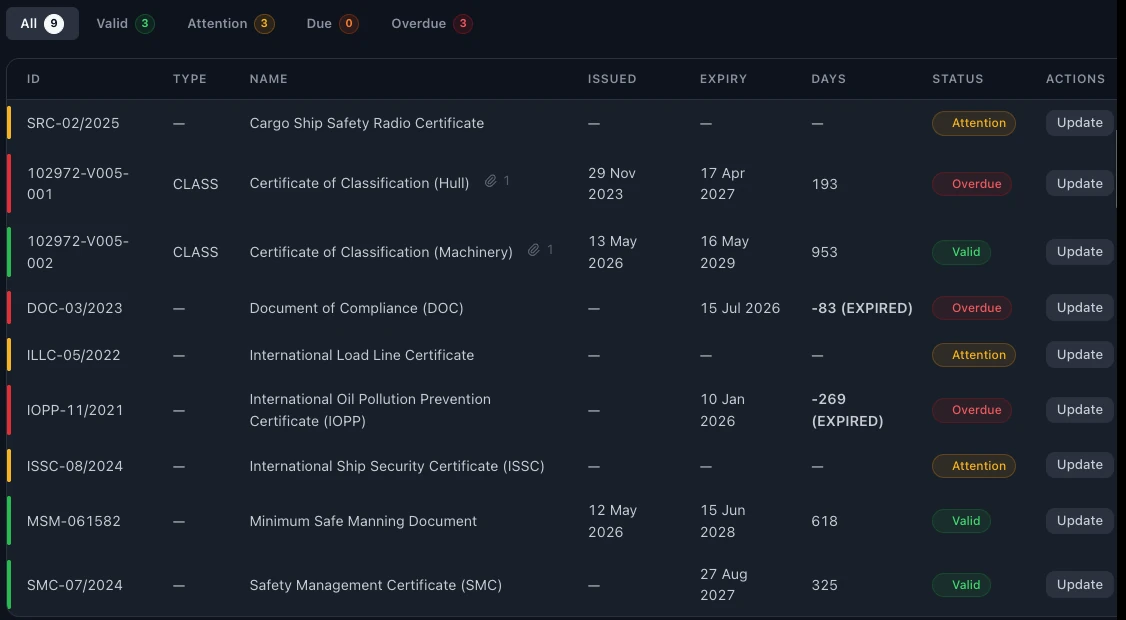
In SEA360 each certificate of each vessel is kept with its expiry date and its survey windows, and the scanned copy is attached. Every certificate is marked valid, attention, due or overdue, and the office gets an email before a certificate or a survey window comes due.
The fleet dashboard shows the certificates due next to each vessel, and the crew see the same list and scans on board, also without a connection.